Genetic Algorithm optimizer for global parameter estimation. More...
#include <GA/GA.h>

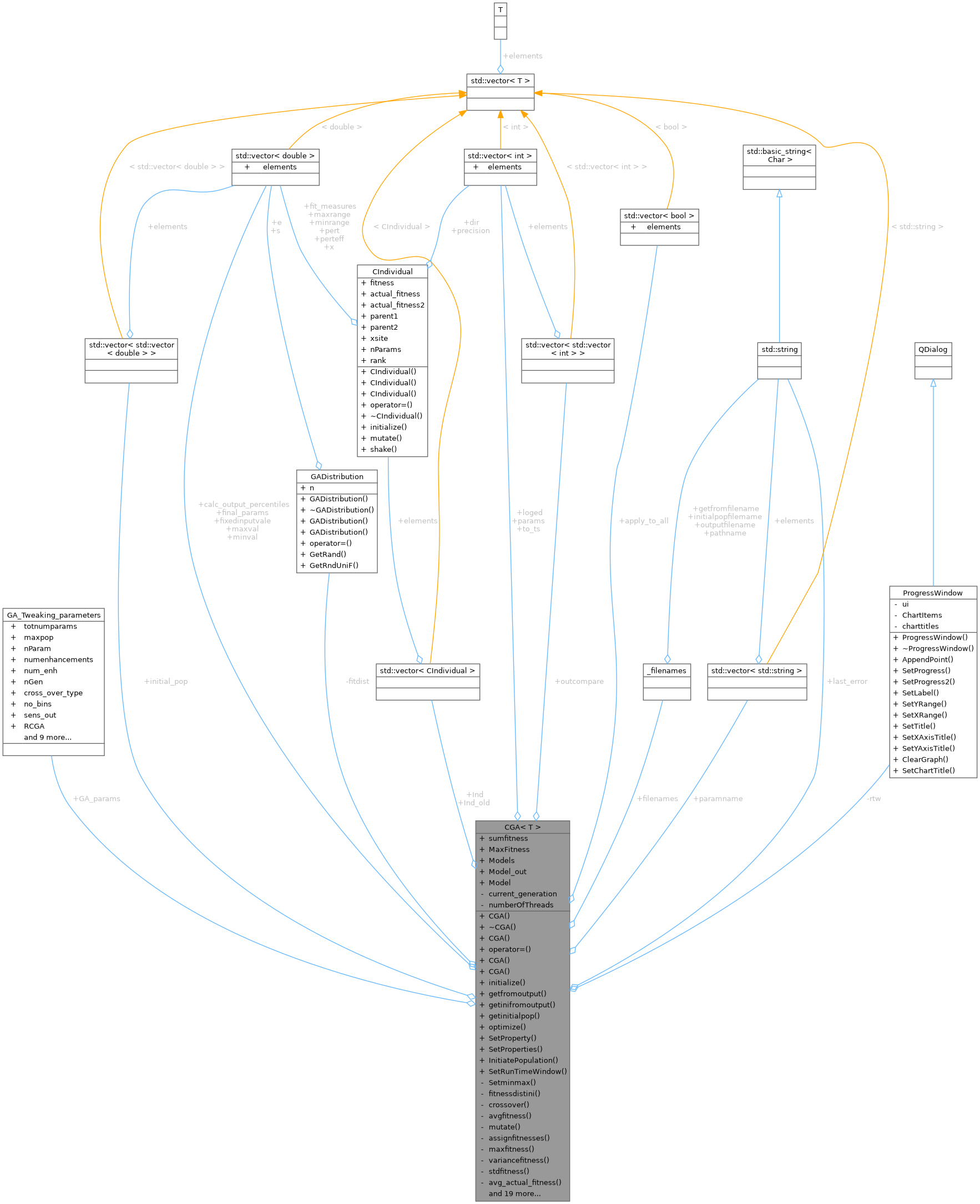
Public Member Functions | |
| CGA () | |
| Default constructor. | |
| virtual | ~CGA () |
| Destructor. | |
| CGA (const CGA &C) | |
| Copy constructor. | |
| CGA | operator= (CGA &C) |
| Assignment operator. | |
| CGA (std::string filename, const T &model) | |
| Constructor from configuration file and model. | |
| CGA (T *model) | |
| Constructor from model pointer. | |
| void | initialize () |
| Initialize GA structures and allocate memory. | |
| double | getfromoutput (std::string filename) |
| Read best solution from previous output file. | |
| void | getinifromoutput (std::string filename) |
| Initialize population from previous output file. | |
| void | getinitialpop (std::string filename) |
| Read initial population from file. | |
| int | optimize () |
| Main optimization loop. | |
| bool | SetProperty (const std::string &varname, const std::string &value) |
| Set GA property from string key-value pair. | |
| bool | SetProperties (const std::map< std::string, std::string > &arguments) |
| Set multiple GA properties from map. | |
| void | InitiatePopulation () |
| Create initial population. | |
| void | SetRunTimeWindow (ProgressReporter *_rtw) |
| Set progress window for GUI updates. | |
Public Attributes | |
| double | sumfitness |
| Sum of all fitness values in current population. | |
| double | MaxFitness |
| Maximum fitness value in current population. | |
| GA_Tweaking_parameters | GA_params |
| GA algorithm configuration parameters. | |
| _filenames | filenames |
| File paths for GA input/output. | |
| std::vector< double > | calc_output_percentiles |
| Percentiles to calculate for output distributions. | |
| std::vector< std::vector< double > > | initial_pop |
| Initial population loaded from file. | |
| std::vector< double > | final_params |
| Final optimized parameter values. | |
| std::vector< int > | params |
| Parameter indices being optimized. | |
| std::vector< int > | loged |
| Flags indicating if parameters are log-transformed. | |
| std::vector< int > | to_ts |
| Time series index for each parameter (if applicable) | |
| std::vector< double > | fixedinputvale |
| Fixed values for non-optimized parameters. | |
| std::vector< double > | minval |
| Lower bounds for each parameter. | |
| std::vector< double > | maxval |
| Upper bounds for each parameter. | |
| std::vector< bool > | apply_to_all |
| Flags indicating if parameter applies to all entities. | |
| std::vector< std::vector< int > > | outcompare |
| Output comparison indices (legacy, may be unused) | |
| std::vector< CIndividual > | Ind |
| Current population of individuals. | |
| std::vector< CIndividual > | Ind_old |
| Previous generation's population. | |
| std::vector< std::string > | paramname |
| Names of parameters being optimized. | |
| std::vector< T > | Models |
| Copies of model for parallel fitness evaluation. | |
| T | Model_out |
| Output model configured with best parameters. | |
| T * | Model |
| Pointer to the model being optimized. | |
| std::string | last_error |
| Last error message from GA execution. | |
Private Member Functions | |
| void | Setminmax (int a, double minrange, double maxrange, int prec) |
| Set parameter bounds and precision. | |
| void | fitnessdistini () |
| Initialize fitness distribution for selection. | |
| void | crossover () |
| Perform crossover operation on population. | |
| double | avgfitness () |
| Calculate average fitness of population. | |
| void | mutate (double mu) |
| Apply mutation to population. | |
| void | assignfitnesses () |
| Evaluate fitness for all individuals in population. | |
| int | maxfitness () |
| Find index of individual with maximum fitness. | |
| double | variancefitness () |
| Calculate variance of population fitness. | |
| double | stdfitness () |
| Calculate standard deviation of population fitness. | |
| double | avg_actual_fitness () |
| Calculate average of actual (untransformed) fitness values. | |
| void | write_to_detailed_GA (std::string s) |
| Write detailed GA information to file. | |
| void | setnumpop (int n) |
| Set population size. | |
| double | avg_inv_actual_fitness () |
| Calculate average of inverse actual fitness. | |
| int | optimize (int nGens, char DefOutPutFileName[]) |
| Optimize for specified number of generations. | |
| void | setnparams (int n) |
| Set number of parameters. | |
| void | assignfixedvalues () |
| Assign fixed values to non-optimized parameters. | |
| void | assignrank () |
| Assign ranks to individuals based on fitness. | |
| void | assignfitness_rank (double N) |
| Assign fitness using rank-based scheme. | |
| void | shake () |
| Apply shake/perturbation to population. | |
| void | crossoverRC () |
| Real-coded crossover operation. | |
| void | getfromfile (char filename[]) |
| Read population from file. | |
| void | fillfitdist () |
| Fill fitness distribution for roulette wheel selection. | |
| double | assignfitnesses (std::vector< double > inp) |
| Evaluate fitness for specific parameter vector. | |
| double | Gradient_Descent (std::vector< double > inp) |
| Perform gradient descent local search. | |
| int | getparamno (int i, int ts) |
| Get parameter index for variable and time series. | |
| int | get_act_paramno (int i) |
| Get active parameter number. | |
| int | get_time_series (int i) |
| Get time series index for parameter. | |
| double | evaluateforward () |
| Evaluate model forward (compute predictions) | |
| double | evaluateforward_mixed (std::vector< double > v) |
| Evaluate model with mixed parameters. | |
Private Attributes | |
| int | current_generation = 0 |
| Current generation counter. | |
| GADistribution | fitdist |
| Fitness distribution for parent selection. | |
| int | numberOfThreads |
| Number of threads for parallel fitness evaluation. | |
| ProgressReporter * | rtw = nullptr |
| Pointer to progress window for GUI updates. | |
Detailed Description
class CGA< T >
Genetic Algorithm optimizer for global parameter estimation.
The CGA class implements a sophisticated genetic algorithm with both binary and real-coded representations for solving complex optimization problems in sediment source fingerprinting.
Algorithm Overview
Genetic Algorithms are population-based metaheuristic optimization methods inspired by natural evolution:
- Initialize: Create random population of candidate solutions
- Evaluate: Calculate fitness (objective function) for each individual
- Select: Choose parents based on fitness (better individuals more likely)
- Crossover: Combine parent solutions to create offspring
- Mutate: Randomly perturb offspring to maintain diversity
- Replace: Form next generation from offspring (and/or parents)
- Repeat: Continue until convergence or generation limit reached
Key Features
- Multiple encoding schemes: Binary and real-coded representations
- Flexible selection methods: Fitness proportionate, rank-based, tournament
- Various crossover operators: Single-point, two-point, uniform, arithmetic
- Adaptive mutation: Self-adjusting based on convergence state
- Hybrid optimization: Optional gradient-based local search
- Parallel evaluation: Thread-safe fitness evaluation
- Progress tracking: GUI integration for real-time monitoring
Usage in SedSat3
GA provides global optimization for source apportionment when:
- Posterior is multimodal (multiple local optima)
- Gradient information unavailable or unreliable
- Robust global search needed
- Derivative-free optimization preferred
GA finds parameter values that minimize error between predicted and observed tracer concentrations, subject to constraints (e.g., contributions sum to 100%).
Mathematical Details
Fitness function (for minimization):
Selection probability (fitness proportionate):
Rank-based fitness:
where N is selection pressure parameter (typically 1.5-2.0)
- Template Parameters
-
T Model class type (e.g., SourceSinkData) that provides: - Parameter setting interface
- Objective function evaluation
- Model predictions
- Note
- Thread-safe for parallel fitness evaluation
- Warning
- May converge to local optimum; multiple runs recommended
- See also
- CIndividual
- GADistribution
- SourceSinkData
Example usage:
Constructor & Destructor Documentation
◆ CGA() [1/4]
◆ ~CGA()
◆ CGA() [2/4]
Copy constructor.
- Parameters
-
C The CGA object to copy from
Creates deep copy including population, settings, and model copies.
Definition at line 169 of file GA.cpp.
References CGA< T >::filenames, CGA< T >::fitdist, CGA< T >::GA_params, CGA< T >::Ind, CGA< T >::loged, CGA< T >::MaxFitness, CGA< T >::paramname, and CGA< T >::params.
◆ CGA() [3/4]
Constructor from configuration file and model.
- Parameters
-
filename Path to GA configuration file model Reference to model to optimize
Initializes GA from configuration file containing parameters, ranges, and algorithm settings.
◆ CGA() [4/4]
Member Function Documentation
◆ assignfitness_rank()
|
private |
Assign fitness using rank-based scheme.
- Parameters
-
N Selection pressure parameter
Calculates fitness from rank using linear ranking formula: fitness(rank) = N - 2(N-1)(rank-1)/(pop_size-1)
Reduces selection pressure compared to raw fitness, preventing premature convergence.
- Parameters
-
N Selection pressure (typically 1.5-2.0)
◆ assignfitnesses() [1/2]
|
private |
Evaluate fitness for all individuals in population.
Calculates objective function value for each individual. Can be parallelized across multiple threads.
- Postcondition
- Each individual's fitness member is updated
- sumfitness and MaxFitness are updated
Definition at line 241 of file GA.cpp.
References x.
◆ assignfitnesses() [2/2]
|
private |
◆ assignfixedvalues()
|
private |
Assign fixed values to non-optimized parameters.
For each individual, sets non-variable parameters to their fixed values from fixedinputvale vector.
◆ assignrank()
|
private |
◆ avg_actual_fitness()
|
private |
◆ avg_inv_actual_fitness()
|
private |
◆ avgfitness()
|
private |
◆ crossover()
|
private |
◆ crossoverRC()
|
private |
Real-coded crossover operation.
Performs crossover for real-valued (continuous) representation using arithmetic or blend crossover operators.
- Note
- Used when GA_params.RCGA is true
- See also
- crossover()
Definition at line 351 of file GA.cpp.
References cross_RC_L(), GetRndUnif(), and x.
◆ evaluateforward()
|
private |
◆ evaluateforward_mixed()
|
private |
Evaluate model with mixed parameters.
- Parameters
-
v Parameter vector (subset or transformed)
- Returns
- Objective function value
Variation of forward evaluation for special parameter handling.
◆ fillfitdist()
|
private |
Fill fitness distribution for roulette wheel selection.
Constructs cumulative distribution function (CDF) from individual fitness values for probabilistic parent selection.
- Precondition
- assignfitnesses() must have been called
- Postcondition
- fitdist is ready for sampling
◆ fitnessdistini()
|
private |
Initialize fitness distribution for selection.
Sets up cumulative fitness distribution (CDF) used in roulette wheel selection for choosing parents.
◆ get_act_paramno()
|
private |
Get active parameter number.
- Parameters
-
i Parameter index
- Returns
- Active parameter index (excluding fixed parameters)
◆ get_time_series()
|
private |
◆ getfromfile()
|
private |
Read population from file.
- Parameters
-
filename Path to population file
Loads population state from checkpoint or previous run.
◆ getfromoutput()
| double CGA< T >::getfromoutput | ( | std::string | filename | ) |
◆ getinifromoutput()
| void CGA< T >::getinifromoutput | ( | std::string | filename | ) |
◆ getinitialpop()
| void CGA< T >::getinitialpop | ( | std::string | filename | ) |
◆ getparamno()
|
private |
◆ Gradient_Descent()
|
private |
Perform gradient descent local search.
- Parameters
-
inp Starting parameter values
- Returns
- Improved fitness after local search
Applies gradient-based refinement to individual for hybrid GA. Accelerates convergence in neighborhood of optimum.
- Note
- Used when GA_params.Steepest_Descent is true
◆ initialize()
| void CGA< T >::initialize | ( | ) |
Initialize GA structures and allocate memory.
Sets up:
- Population arrays
- Fitness distribution
- Model copies for parallel evaluation
- Parameter ranges
- Precondition
- GA_params must be configured
- Parameter ranges (minval, maxval) must be set
- Postcondition
- Ready for InitiatePopulation() call
◆ InitiatePopulation()
| void CGA< T >::InitiatePopulation | ( | ) |
Create initial population.
Generates starting population using one of:
- Random initialization within parameter bounds (default)
- Loading from file (if readfromgafile is true)
- Custom initial population (if initial_pop is set)
- Precondition
- GA must be initialized via initialize()
- Parameter bounds must be set
- Postcondition
- Ind vector contains maxpop individuals
- All individuals have random or loaded parameter values
- See also
- initialize()
Definition at line 166 of file GA.hpp.
References lognormal.
◆ maxfitness()
|
private |
◆ mutate()
|
private |
◆ operator=()
Assignment operator.
- Parameters
-
C The CGA object to assign from
- Returns
- Reference to this object
Copies all data from another GA object.
Definition at line 186 of file GA.cpp.
References CGA< T >::filenames, CGA< T >::fitdist, CGA< T >::GA_params, CGA< T >::Ind, CGA< T >::Ind_old, CGA< T >::loged, CGA< T >::MaxFitness, CGA< T >::paramname, and CGA< T >::params.
◆ optimize() [1/2]
| int CGA< T >::optimize | ( | ) |
Main optimization loop.
- Returns
- 0 on success, negative on error
Executes complete GA workflow:
- Initialize/load population
- Evaluate fitness
- For each generation: a. Selection b. Crossover c. Mutation d. Fitness evaluation e. Statistics and output
- Return best solution
- Precondition
- Population must be initialized via InitiatePopulation()
- Postcondition
- final_params contains best solution
- Results written to output file
- See also
- InitiatePopulation()
Definition at line 394 of file GA.cpp.
References x.
◆ optimize() [2/2]
|
private |
Optimize for specified number of generations.
- Parameters
-
nGens Number of generations to evolve DefOutPutFileName Default output filename
- Returns
- 0 on success
Alternative optimize interface with explicit generation count and output file specification.
◆ Setminmax()
|
private |
◆ setnparams()
|
private |
◆ setnumpop()
|
private |
Set population size.
- Parameters
-
n Number of individuals
Allocates memory for population of size n.
- Postcondition
- GA_params.maxpop is updated
- Ind and Ind_old vectors are resized
Definition at line 142 of file GA.cpp.
References CIndividual::maxrange, CIndividual::minrange, CIndividual::nParams, and CIndividual::precision.
◆ SetProperties()
| bool CGA< T >::SetProperties | ( | const std::map< std::string, std::string > & | arguments | ) |
◆ SetProperty()
| bool CGA< T >::SetProperty | ( | const std::string & | varname, |
| const std::string & | value | ||
| ) |
Set GA property from string key-value pair.
- Parameters
-
varname Property name (e.g., "population_size", "mutation_rate") value Property value as string
- Returns
- true if property was recognized and set successfully
Allows configuration from text files or user input. Supports all fields in GA_params structure.
◆ SetRunTimeWindow()
|
inline |
Set progress window for GUI updates.
- Parameters
-
_rtw Pointer to ProgressReporter object
Links GA to progress dialog for real-time status updates including:
- Current generation number
- Best fitness value
- Population statistics
- Convergence plots
Definition at line 686 of file GA.h.
References CGA< T >::rtw.
◆ shake()
|
private |
◆ stdfitness()
|
private |
◆ variancefitness()
|
private |
◆ write_to_detailed_GA()
|
private |
Member Data Documentation
◆ apply_to_all
| std::vector<bool> CGA< T >::apply_to_all |
◆ calc_output_percentiles
| std::vector<double> CGA< T >::calc_output_percentiles |
◆ current_generation
|
private |
◆ filenames
| _filenames CGA< T >::filenames |
File paths for GA input/output.
Configuration structure containing paths for initialization files, results output, and checkpoint files.
Definition at line 382 of file GA.h.
Referenced by CGA< T >::CGA(), and CGA< T >::operator=().
◆ final_params
| std::vector<double> CGA< T >::final_params |
◆ fitdist
|
private |
Fitness distribution for parent selection.
Cumulative distribution function used in roulette wheel selection.
Definition at line 986 of file GA.h.
Referenced by CGA< T >::CGA(), and CGA< T >::operator=().
◆ fixedinputvale
| std::vector<double> CGA< T >::fixedinputvale |
◆ GA_params
| GA_Tweaking_parameters CGA< T >::GA_params |
GA algorithm configuration parameters.
All tuning parameters controlling GA behavior. Modify before calling initialize() or optimize().
Definition at line 374 of file GA.h.
Referenced by CGA< T >::CGA(), and CGA< T >::operator=().
◆ Ind
| std::vector<CIndividual> CGA< T >::Ind |
Current population of individuals.
Active population of candidate solutions being evolved. Size: GA_params.maxpop
Definition at line 475 of file GA.h.
Referenced by CGA< T >::CGA(), and CGA< T >::operator=().
◆ Ind_old
| std::vector<CIndividual> CGA< T >::Ind_old |
Previous generation's population.
Backup of population from previous generation for comparison and elitism strategies.
Definition at line 483 of file GA.h.
Referenced by CGA< T >::operator=().
◆ initial_pop
| std::vector<std::vector<double> > CGA< T >::initial_pop |
◆ last_error
| std::string CGA< T >::last_error |
◆ loged
| std::vector<int> CGA< T >::loged |
Flags indicating if parameters are log-transformed.
If loged[i] is true, parameter i is optimized in log-space. Useful for parameters spanning multiple orders of magnitude.
Definition at line 423 of file GA.h.
Referenced by CGA< T >::CGA(), and CGA< T >::operator=().
◆ MaxFitness
| double CGA< T >::MaxFitness |
Maximum fitness value in current population.
Tracks the best individual's fitness for convergence monitoring and termination criteria.
Definition at line 366 of file GA.h.
Referenced by CGA< T >::CGA(), and CGA< T >::operator=().
◆ maxval
| std::vector<double> CGA< T >::maxval |
◆ minval
| std::vector<double> CGA< T >::minval |
◆ Model
| T* CGA< T >::Model |
◆ Model_out
| T CGA< T >::Model_out |
◆ Models
| std::vector<T> CGA< T >::Models |
◆ numberOfThreads
|
private |
◆ outcompare
| std::vector<std::vector<int> > CGA< T >::outcompare |
◆ paramname
| std::vector<std::string> CGA< T >::paramname |
Names of parameters being optimized.
Human-readable labels for each parameter (e.g., "Agricultural", "Forest", "Urban") used in output files and visualization.
Definition at line 491 of file GA.h.
Referenced by CGA< T >::CGA(), and CGA< T >::operator=().
◆ params
| std::vector<int> CGA< T >::params |
Parameter indices being optimized.
Maps GA parameter space to model parameter space. Allows optimizing subset of parameters while fixing others.
Definition at line 415 of file GA.h.
Referenced by CGA< T >::CGA(), and CGA< T >::operator=().
◆ rtw
|
private |
Pointer to progress window for GUI updates.
If not nullptr, GA updates progress bar and displays current generation, best fitness, convergence plot, etc.
Definition at line 1002 of file GA.h.
Referenced by CGA< T >::SetRunTimeWindow().
◆ sumfitness
| double CGA< T >::sumfitness |
◆ to_ts
| std::vector<int> CGA< T >::to_ts |
The documentation for this class was generated from the following files: